

Sonya R. Tsibranska-Gyoreva, Ph.D.
Interests
- Emulsions and Emulsification
- Nanoparticle Synthesis
- Bulk Rheology of Emulsions
- Molecular Dynamic Simulations
Publications
Most recent publications
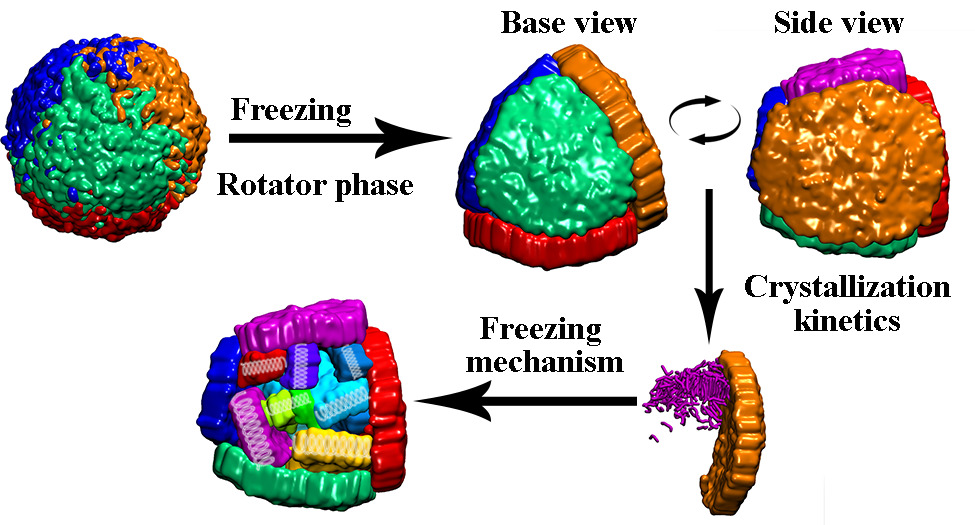
Molecular dynamics study of hexadecane droplets: Kinetics and mechanism of freezing
This work presents results, aimed at identifying the crystallization mechanism of surfactant-stabilized hexadecane-in-water droplet with 15 nm diameter at the molecular level. The question is addressed by atomistic molecular dynamics simulations of models consisting of ca. 2 million atoms. To represent as closely as possible real-world systems, a procedure for constructing droplets of different sizes is developed, allowing control of the surfactant surface coverage. Two crystallization protocols are applied: slow freezing, in which the surface solidifies first, followed by relaxation and subsequent cooling to induce crystallization in the bulk, and fast freezing, in which the droplet is directly cooled to the final temperature, leading to simultaneous surface and core crystallization. A few key results may be outlined. The droplet surface always freezes first. Nucleation occurs stochastically at multiple independent sites, gradually propagating over the surface. Both shell and core undergo heterogeneous nucleation initiated by surfactant molecules. The nuclei in the core typically form close to the surface. The cooling procedure affects the spatial freezing pathway and molecular ordering in the drop core. The preferred orientation of bulk crystallites relative to the originating surface is nearly perpendicular. Once solidified, the surface alone is sufficient to induce droplet deformation to a triangular prism-like shape, additionally stabilized by the bulk crystallites. The deformation is a clear indication of a rotator phase, stable over hundreds of nanoseconds, further confirmed by the fraction of gauche conformations, P2 order parameters, and radial distribution functions. These findings agree with and complement experimental data and provide molecular-level verification of the experimentally observed fundamental difference in the stability of hexadecane rotator phase: transient in bulk and stable under micro- and nanoconfinement. This is the fundamental knowledge on microscopic freezing mechanisms of hexadecane and similar even-parity alkane-based materials at interfaces.
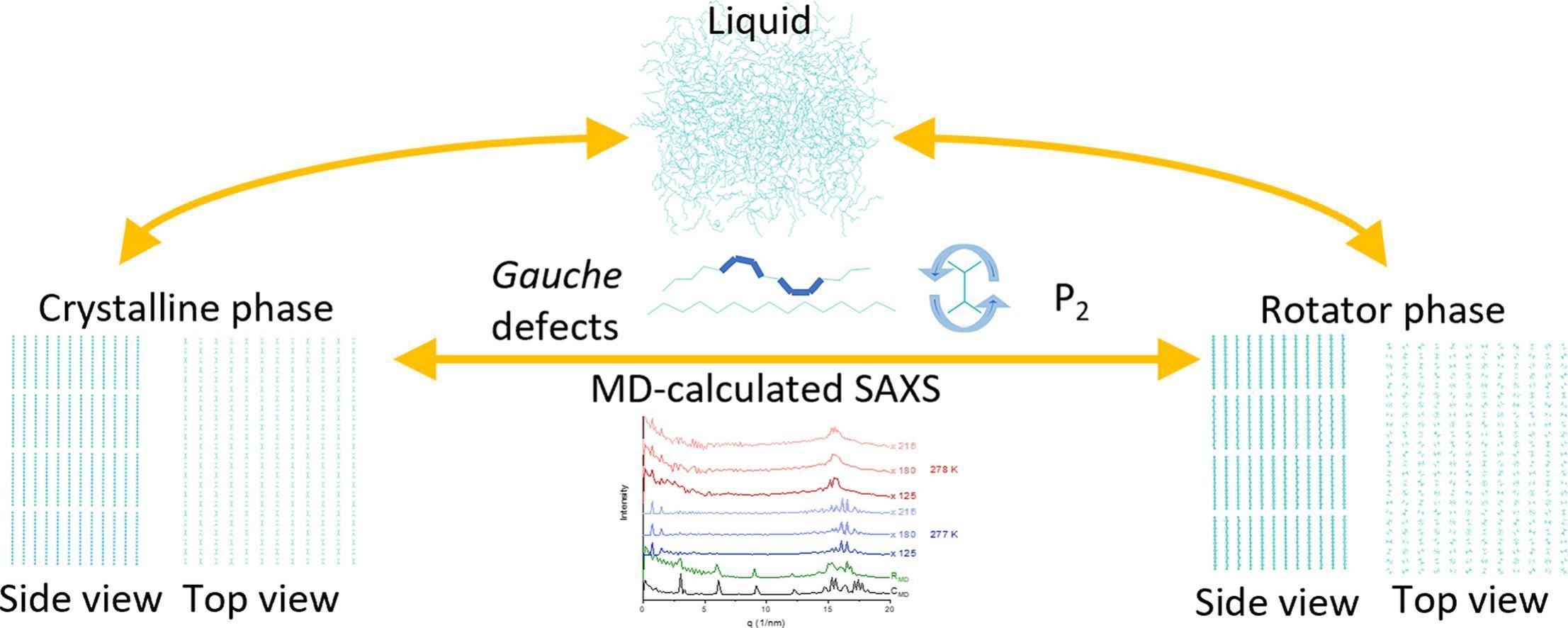
Computational freezing of pentadecane
Molecular dynamics simulations are employed to investigate the crystallization of pentadecane-containing systems. Reference crystalline and rotator phase constructed from crystallographic data benchmark the structures formed upon cooling. Phase identification is achieved through global and local structural descriptors, with the fraction of gauche conformations and angular P₂ profiles outlined as the most sensitive indicators.
Pentadecane exhibits a markedly more stable rotator phase than hexadecane. This is confirmed by simulations spanning more than 30 K for the reference rotator phase. In this temperature range, a model regular rotator phase of pentadecane remains stable without undergoing significant structural changes, showing high reproducibility across independent trajectories. This contrasts hexadecane, for which a rotator phase rapidly transforms toward a triclinic structure [Iliev et al. 2023]. The presence of a surfactant in the system promotes heterogeneous nucleation, shifts crystallization to higher temperatures, and stabilizes the rotator phase, in agreement with experiments.
A computationally efficient protocol for simulating SAXS spectra from MD trajectories is proposed. The simulated spectra align very well with experimental data for both crystalline and rotator phases. Crystallographic lattice parameters can be extracted from the most intense SAXS peaks, even for experimentally unknown structures, demonstrating the general applicability of the approach to solid-state phase analysis.
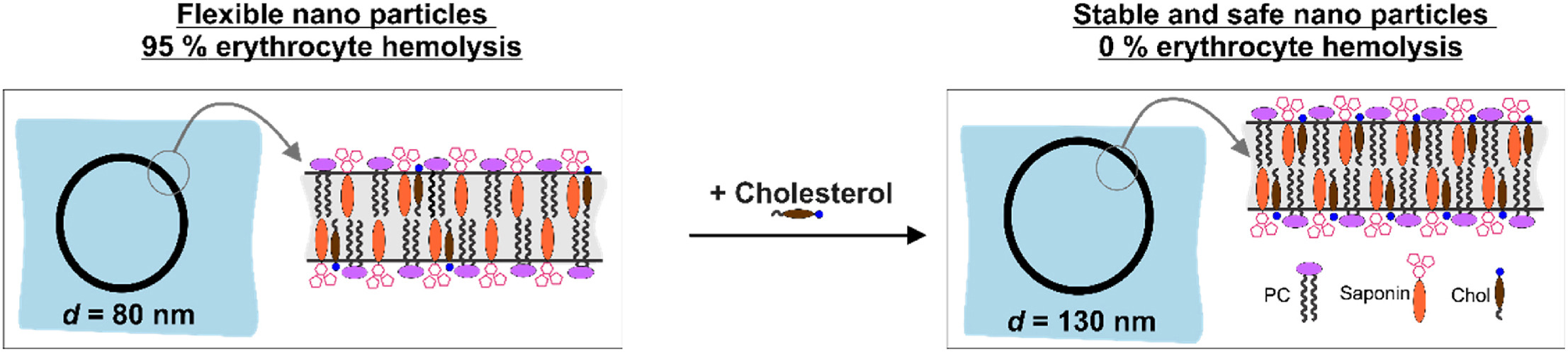
ISCOM-type matrix from beta-escin and glycyrrhizin saponins
Background and aims
Nanotechnology provides the opportunity for construction of modern transport devices such as nanoparticles for a variety of applications in the field of medicine. A novel experimental protocol for the formation of saponin-cholesterol-phospholipid nanoparticles of vesicular structure has been developed and applied to prepare stable nanoparticles using escin or glycyrrhizin as saponins.
Methods
The methods for nanoparticle construction include a sonication at 90 °C of the initial mixture of components, followed by an additional sonication on the next day for incorporation of an additional amount of cholesterol, thus forming stable unilamellar vesicles. Tests and assays for cell viability, erythrocyte hemolysis, flow cytometry, and fluorescent microscopy analyses have been performed.
Results
By selecting appropriate component ratios, stable and safe particles were formulated with respect to the tested bio-cells. The prepared nanoparticles have mean diameter between 70 and 130 nm, depending on their composition. The versatility of these nanoparticles allows for the encapsulation of various molecules, either within the vesicle interior for water-soluble components or within the vesicle walls for hydrophobic components. The saponin particles formed after cholesterol post-addition (E3-M2) are stable and 100 % of the cells remain viable even after 10-times dilution of the initial particle suspension. These particles are successful included into isolated mouse macrophages.
Conclusions
Among the variety of generated nanoparticles, the E3-M2 particles demonstrated properties of safe and efficient devices for future vaccine design and antigen targeting to immune system.
Types of phases obtained by molecular dynamics simulations upon freezing of hexadecane-containing systems
Medium- to long-chain alkanes can form upon cooling intermediate phases between isotropic liquid and solid crystalline, called rotator phases, where relative freedom of the molecules to rotate about their long axis is combined with long range translational order. Rotator phases are well documented experimentally but the mechanism of their formation at the molecular level is still not fully explained. In a previous work, we have shown that molecular dynamics simulations can produce rotator phases upon cooling of hexadecane [S. Iliev et al., J. Col. Int. Sci., 2023, 638, 743]. The aim of the current work is to develop a procedure to identify the specific ordered phase obtained in the simulations. The influence of the cooling rate on the freezing process of hexadecane (bulk and surfactant-interfaced to water) is tested as well. Several parameters are combined to quantify the degree of ordering and the type of phase in the studied systems. These are the tilt angle of the molecules with respect to the crystallite plane, the radial distribution function of the centre of mass of the molecules in the crystallite, the percentage of the gauche torsion angles in the molecules, the angle of the second principal axis of each molecule with respect to the x axis of the coordinate system, and estimates from Voronoi analysis. The results show that the systems form a rotator phase, which transitions gradually towards the thermodynamically most stable triclinic crystal, and the transformation progresses to different extent depending on the system. The influence of the cooling rate is related only to the size of the largest crystallite formed, the other parameters of the freezing process remain unaffected. The work also presents a robust procedure for obtaining and identifying different types of ordered phases in alkane-containing systems with thoroughly tested computational protocol and a comprehensive set of structural analyses. Several key characteristics are advanced, compared to previous research [Ryckaert et al., Mol. Phys., 1989, 67, 957; Wentzel et al., J. Chem. Phys. 2011, 134, 224504], namely, a new methodology is proposed to compute the unit cell deformation parameter and azimuthal angle from MD simulation trajectories of the freezing process in alkane-containing systems. The suggested structural analysis, which is independent of the coordinate system, is applicable to any linear-chain system with polycrystalline structure.

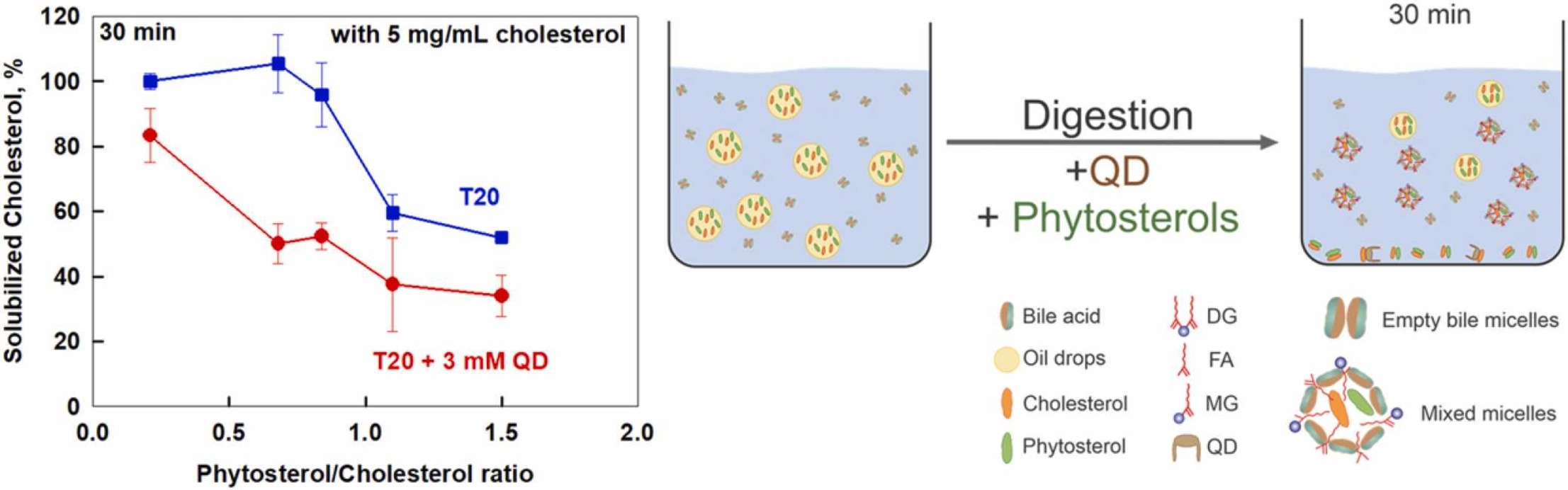
Cholesterol solubilization: Interplay between phytosterols, saponins and lipid digestion products
High plasma concentrations of cholesterol are associated with cardio-vascular disease complications and high risk of myocardial infarction. The absorption of dietary cholesterol depends on its bioaccessibility, which is in turn influenced by phytosterols, saponins and lipid digestion products. Therefore, we explored the interplay between phytosterols, Quillaja Dry saponin extract (QD), their combinations and lipid digestion on cholesterol bioaccessibility via an in vitro.