

Relationships between composition, microstructure, rheology, and functional performance in carbopol-based emulgels and bigels
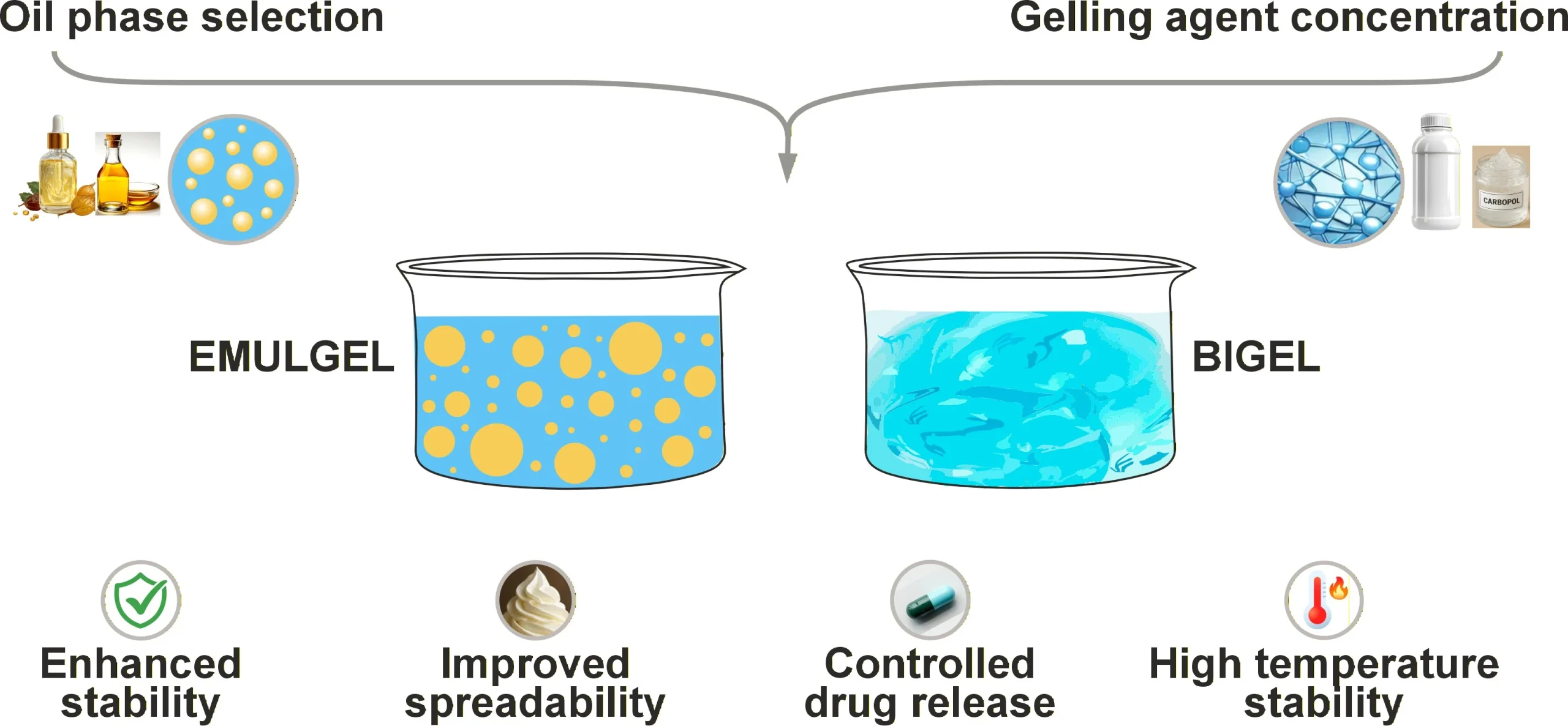
This study investigates composition-microstructure-rheology-performance relationships in Carbopol-based emulgels and bigels containing different oils. Optical microscopy revealed polydisperse droplets in liquid paraffin, isopropyl myristate, and almond oil formulations, whereas cetyl alcohol systems exhibited larger, irregular birefringent particles with Maltese cross-like patterns. All formulations showed shear-thinning behavior and predominantly elastic responses (G′ > G″). Cetyl alcohol-based emulgels exhibited higher elastic moduli and viscosity than those containing other oils. Increasing Carbopol concentration from 0.5% to 1% enhanced elasticity and viscosity, while reducing viscosity losses during heating from 10 to 40 °C from 35 to 40% to 11–26%. Bigels containing 20% and 30% oleogel exhibited elastic moduli approximately 20% and 80% higher than the hydrogel, respectively, suggesting possible synergistic mechanical reinforcement. Correlation analysis revealed relationships between rheological parameters, drug release, and spreadability. Viscosities above approximately 150 Pa·s were associated with reduced drug release, while moderate viscosity favored a balance between structural integrity, spreadability, and release performance. The absence of visible changes after 12 months of storage was consistent with temperature-ramp rheology results, suggesting potential use as a preliminary screening tool for formulation stability. Overall, oil phase selection, phase structuring, and Carbopol concentration enable tailoring stable and functional emulgel and bigel formulations for pharmaceutical and cosmetic applications.