

Modular synthesis of amphiphilic cyclic brush polymers with polymethacrylate core and their dual self-organization into unimolecular micelles and multimolecular aggregates
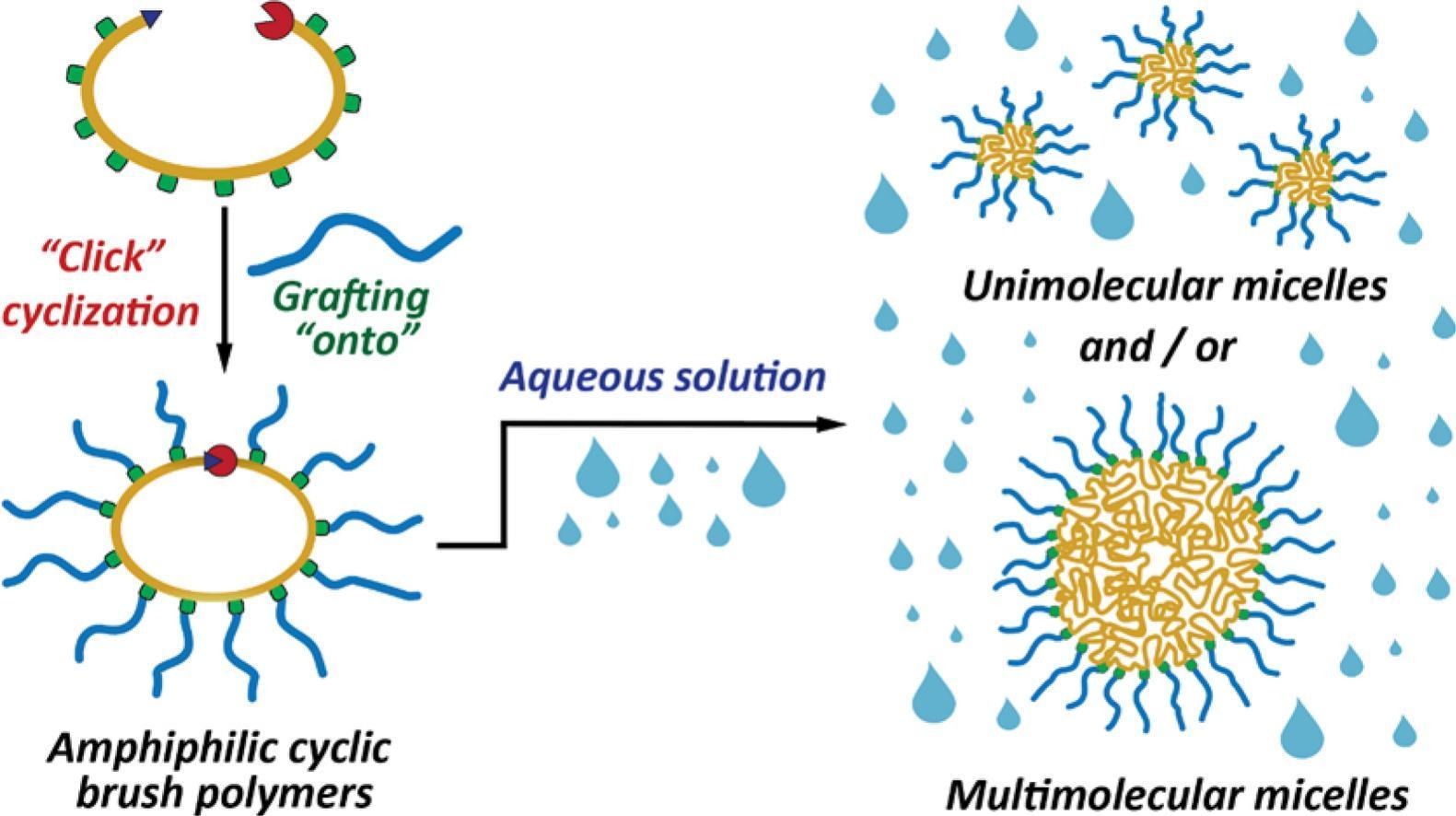
The synthesis of cyclic polymer brushes with a hydrophobic polymethacrylate backbone and hydrophilic side arms via a combination of atom transfer radical polymerization (ATRP), cyclization via copper-catalyzed azide-alkyne cycloaddition (CuAAC) and grafting via CuAAC is reported. Poly(2-isopropyl-2-oxazoline) and polyethers such as poly(ethylene glycol) and polyglycidol were employed for grafting onto the polymethacrylate cycle. The modular sequence afforded a family of cyclic brush copolymers whose backbone composition, and successive functionalization and grafting steps were characterized by NMR spectroscopy and SEC. The behavior of these copolymers in aqueous solution was further investigated, demonstrating their ability to form stable unimolecular micelles and aggregates. The aqueous solution properties were explored by a variety of methods – dye solubilization, turbidimetry, light scattering, analytical ultracentrifugation, and cryogenic transmission electron microscopy. The particles were precisely parametrized in terms of size, molar mass, aggregation number, and morphology. Preliminary experiments with cell lines of human origin showed high cytocompatibility of the cyclic polymer brushes suggesting their appropriateness as drug delivery platforms.