

Exploring digestion-induced fed-state simulated intestinal media with a lipid fraction and compositional variability
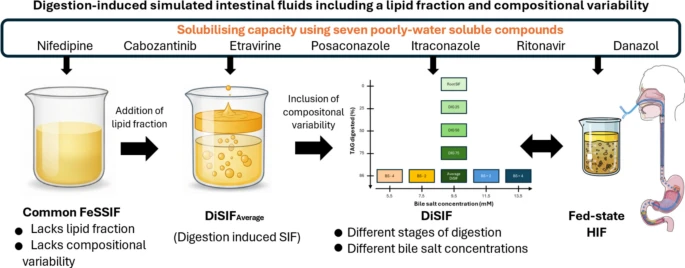
Food effects on intestinal drug solubility and dissolution are a critical consideration in drug development, commonly investigated using simulated intestinal fluids (SIF) such as FaSSIF and FeSSIF. While these media represent average fasted- and fed-state conditions, their lack of a lipid fraction and disregard for compositional variability limit their physiological relevance and predictive power. To address these limitations, this proof-of-concept study introduces a novel set of fed-state SIF, termed digestion-induced SIF (DiSIF), featuring two key enhancements: (i) inclusion of a physiologically relevant lipid fraction generated through in vitro digestion of a liquid meal, and (ii) incorporation of variability via modulation of bile salt concentration and stage of digestion. Nine DiSIF media were developed to reflect both the average composition and the variability observed in fed-state human intestinal fluids (HIF). Overall, DiSIF media adequately predicted the micellar solubility of seven poorly water-soluble model compounds. Unlike commonly used SIF, they also enabled estimation of drug solubilization in total samples containing both micellar and lipid fractions, as observed in fed-state HIF. Furthermore, the media’s compositional variability allowed for the prediction of compound sensitivity to physiological variability with relative accuracy. These findings support further refinement and validation of DiSIF media as a versatile tool for formulation development and food-effect prediction in oral drug delivery.