

Effect of cyclic molecules on salt curves of mixed anionic-zwitterionic surfactant solutions
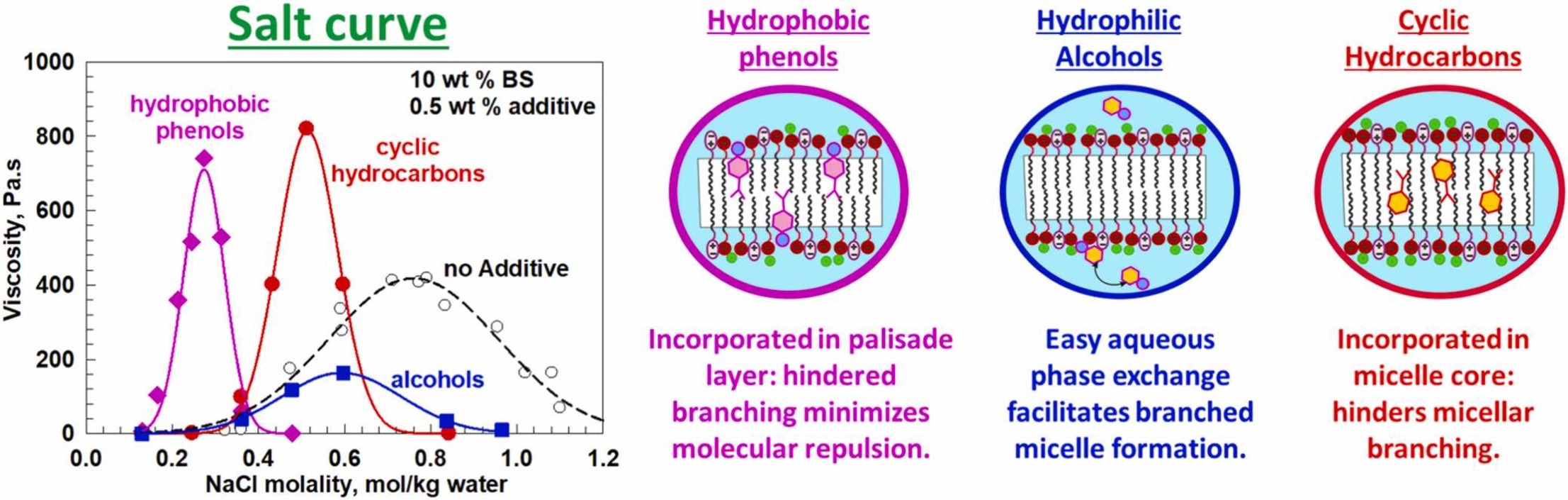
The effect of twelve cyclic molecules on the rheological response of a 10 wt% mixture of sodium lauryl ether sulfate and cocoamidopropyl betaine (BS) was evaluated. The results demonstrate that all studied additives effectively reduced the salt concentration required to reach peak viscosity and narrowed the width of the salt curve. The specific effect on the magnitude of the peak viscosity depends on the molecular structure of the additive. Hydrocarbons, along with hydrophobic phenols, increase the peak viscosity, while alcohols and simple phenol, decrease it. SAXS and NMR measurements revealed that hydrocarbons are primarily incorporated into the micellar core, and the observed viscosity enhancement is attributed to the suppression of micellar branching. In contrast, molecules possessing an OH-group intercalate between the surfactant headgroups or reside at the micellar surface. For hydrophobic phenols, the ability to form stable hydrogen bonds results in a significant increase in the maximum viscosity. This interaction substantially reduces the salt concentration required to reach peak viscosity; in this case, the micellar charge density remains relatively high, and electrostatic repulsion hinders micellar branching. On the other hand, simple phenols and alcohols decrease viscosity because their higher water solubility allows them to easily redistribute across different regions of the micelle surface, thereby facilitating micellar branching. The dimensionless parameters accounting for the effect of the studied additives on the salt curve characteristics were determined. These parameters were shown to depend on a composite molecular parameter, defined as the ratio of the surfactant volume to the additive volume multiplied by the octanol–water partition coefficient, vBS/vALogP.