

Self-inflating volatile oil-shell bubbles and foams driven by interfacial air diffusion
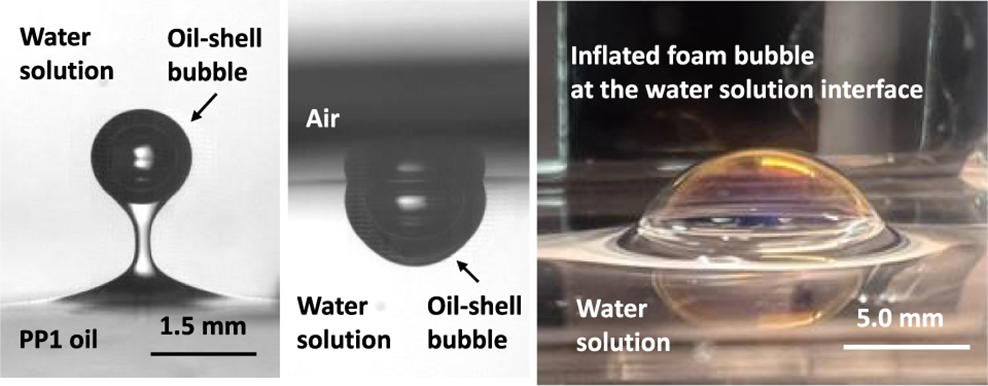
Recent studies have shown that bubbles inside a volatile liquid can spontaneously grow in the absence of bulk gas supersaturation through diffusion of air driven by differences in its partial pressure. Here, we demonstrate a distinct manifestation of this phenomenon in which perfluorocarbon oil-shell bubbles, formed following bubble detachment from a perfluorocarbon oil (PP1, F2 Chemicals)–water interface, become trapped and spontaneously expand at the water–air interface. Addition of the anionic fluorosurfactant Capstone FS-60 to the aqueous phase stabilizes the detached oil-shell bubbles at the water–air interface. The bubbles spontaneously grow from an initial diameter of approximately 1.5 mm to several millimeters within a few minutes. The initial growth rate reaches about 11 μm/s, substantially exceeding that observed for bubbles trapped at the PP1–water interface. Bubble-bursting measurements indicate progressive thinning and eventual depletion of the PP1 shell at bubble radii of approximately 2.5–3.0 mm. Bubble growth nevertheless continues after shell depletion as the system transitions into a surfactant-stabilized foam bubble containing PP1 vapor. An interfacial air-diffusion model attributes the enhanced growth to the short diffusion path across the thin liquid film separating the bubble from the atmosphere, driven by the difference in air partial pressure between the PP1-vapor-containing bubble interior and the surrounding atmosphere. Finally, multiple oil-shell bubbles form self-expanding foam clusters that continue to grow for hours, increasing their apparent foam volume by more than 2 orders of magnitude. These findings demonstrate how modifying the mass-transfer geometry of interfacial air diffusion can strongly accelerate bubble growth and enable the formation of self-inflating bubbles and foams under ambient conditions.