

Role of particle size and mono-to-polyester ratio on gelation behavior of sucrose ester dispersions
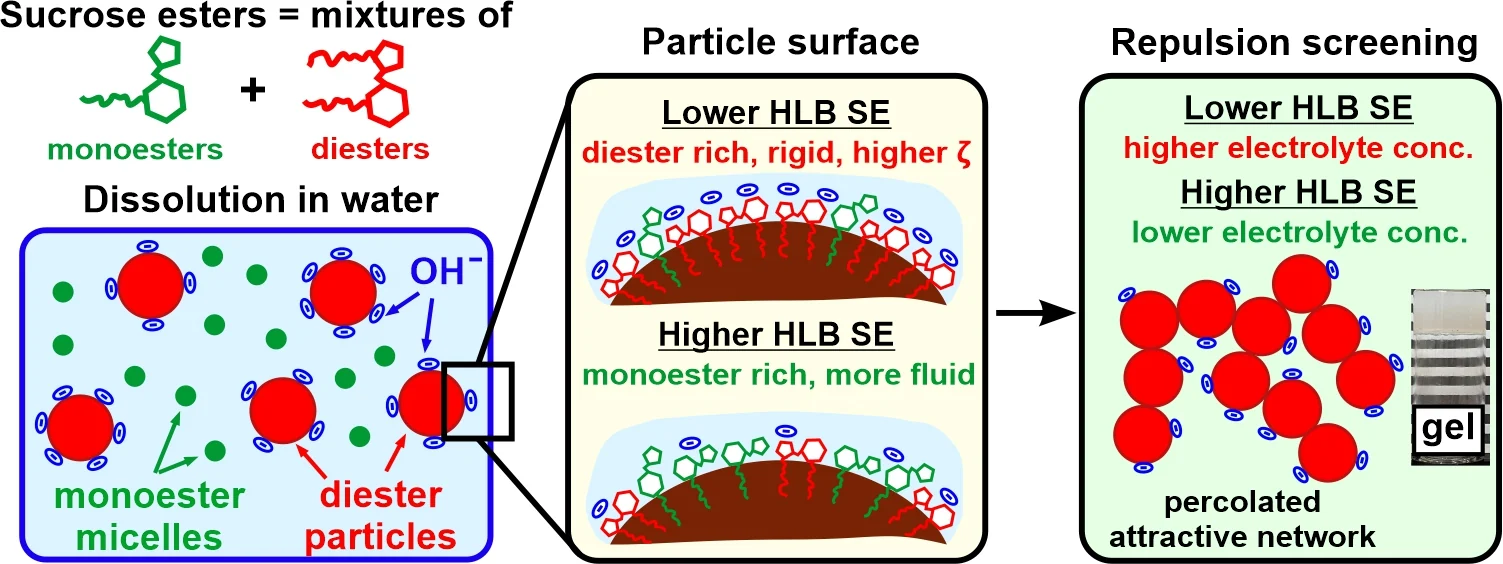
Commercial nonionic sucrose ester surfactants (SEs) contain varying ratios of monoesters and polyesters. In our previous study, we found that when the mono-to-polyester (MP) ratio is close to 1, SE dispersions can form hydrogels at very low surfactant and electrolyte concentrations. In the current study, we systematically investigate how the MP ratio and particle size affect the salt-induced gelation process. We reveal that SE dispersions form hydrogels only within a certain MP range. At low MP ratios (<0.4), micrometer-sized particles form and sediment, preventing gel formation, whereas at high MP ratios (≳3), particle concentration decreases, confining gelation to a very narrow electrolyte region. Sonication significantly reduces particle size across all dispersions, expanding the gelation domain down to MP ≈ 0.3. The critical salt concentration required for hydrogel formation exhibits a maximum as a function of MP ratio at MP ≈ 0.43, which is explained with the highest measured zeta potential for these particles. The obtained results support the hypothesis that increasing the monoester content enhances surface mobility, suppresses hydroxide ion adsorption, and reduces particle charge, thereby lowering the threshold electrolyte concentration. Finally, particle size reduction enhances overall gel strength and lowers the minimum surfactant concentration required for gelation. These findings enable the rational design of simple, biodegradable hydrogels with tunable properties for future applications in food, pharmaceutical, and cosmetic formulations.