

Effect of hydroxypropyl cellulose on the stability and oral absorption of glibenclamide amorphous solid dispersions
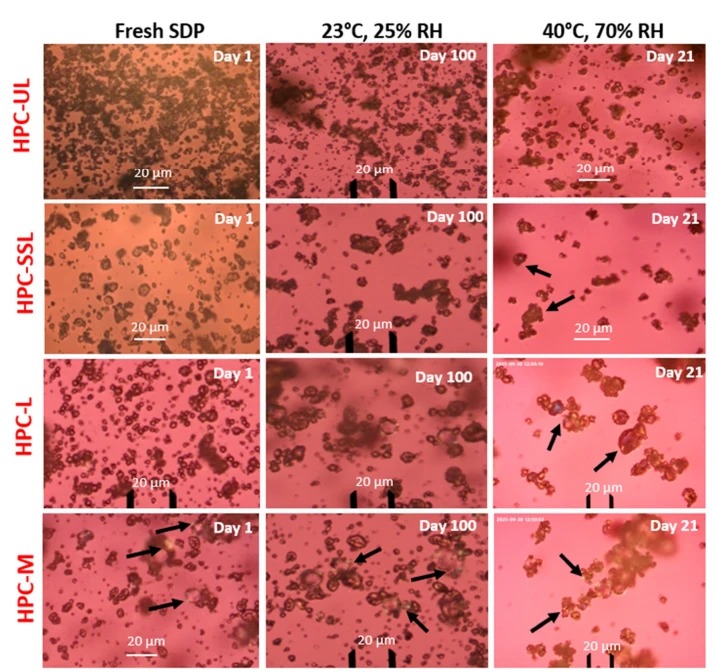
Polymers are widely used in amorphous solid dispersions of poorly water-soluble drugs to provide solid-state and supersaturation stability. While low-molecular-weight hydroxypropyl cellulose polymers usually provide better formulation stability, their effect on high-drug-load formulations is still unclear. Whether spray-dried formulations which sustain supersaturated solutions in vitro can increase oral absorption in vivo also remains to be verified. Thus, we investigated the effect of the molecular weight of hydroxypropyl cellulose polymers on solid-state stability, dissolution, supersaturation stability and absorption of glibenclamide. Amorphous drug formulations were prepared by spray drying and solvent casting. Solid-state analysis was performed using polarised light microscopy (PLM), differential scanning calorimetry, and wide-angle X-ray diffraction (WAXS). Dissolution was studied in porcine bile extract-based media at fasted- and fed-state conditions. In situ rat perfusion was used to assess intestinal absorption. All formulations remained amorphous by PLM and WAXS up to 100 days under ambient storage conditions. Under accelerated stability test conditions, however, lower-molecular-weight polymers consistently provided superior stability, most likely due to improved drug–polymer mixing. Dissolution studies revealed that low-molecular-weight hydroxypropyl cellulose polymers stabilised supersaturated solutions for up to 120 min. In situ rat perfusion showed much higher intestinal absorption compared to the crystalline reference. The present study shows that lower-molecular-weight HPCs enhance the performance of high-drug-load ASDs, providing high solid-state and supersaturation stability, as well as significantly improving intestinal absorption.