


Zlatina G. Mitrinova, Ph.D.
Interests
- Foam formation, stability and rheology
- Surfactant solution phase behavior and rheology
Bio
Zlatina Mitrinova received M.Sc. in Colloidal systems in contemporary science and technology (2010), Ph.D. in Physical chemistry-microkinetics (2015), in the Faculty of Chemistry and Pharmacy, Sofia University, Bulgaria. She is PostDoc in the Department since January 2015. She has been researcher R2 in a projects with public finances. Her research interests include: foam formation and stability ; rheology of foams ; foam stability in the presence of antifoams; surfactant solutions aggregation and rheology. So far, she has published 8 research articles, cited over 184 times in the scientific literature (h-index =5). She has been participating in projects with international companies (Unilever, Wacker, Lubrizol, Altana, BYK Chemie).
Publications
Most recent publications
Microemulsions of essential oils: Characterization and phase behavior
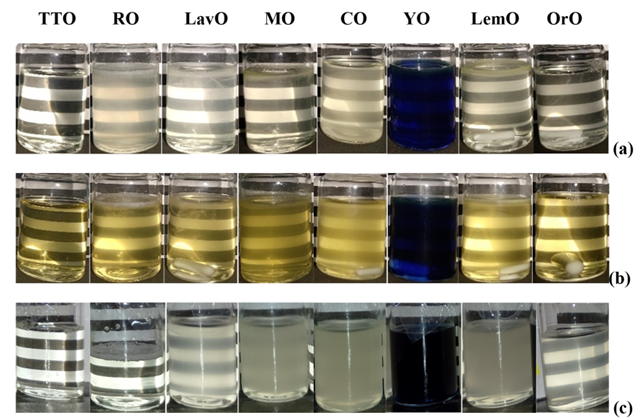
Essential oils are a key ingredient in foods, beverages, and personal- and home-care products due to their flavors, scents, and various biological activities. This study investigates the capacity of polysorbate 60 (PS60) micelles to solubilize eight essential oils classified into two groups based on their composition. The first group (tea tree, rose, lavender, and melissa oils) contains more than 40% polar aliphatic or alicyclic alcohols or aldehydes, whereas the oils from the second group (chamomile, yarrow, lemon, and orange oils) contain less than 20% of these compounds. The efficient solubilization of the studied essential oils within PS60 micelles is proposed to occur via a mechanism involving two steps: (1) the formation of mixed micelles between PS60 molecules and the polar alcohol or aldehyde constituents of the essential oils, and (2) the dehydration of PS60 ethoxy groups in the presence of highly water-soluble additives (such as citric acid and sodium citrate), which is suggested to decrease the hydrophilic barrier of the micellar corona, thereby facilitating the mass transfer of hydrophobic oil molecules into the micellar core. Stable, transparent microemulsions form only with the first group of essential oils in a certain concentration range. The second step in the proposed mechanism leads to the unexpected finding that reducing the concentration of water-soluble additives, such as citric acid and sodium citrate, impairs solubilization by allowing the micellar corona to rehydrate.
Effect of cyclic molecules on salt curves of mixed anionic-zwitterionic surfactant solutions
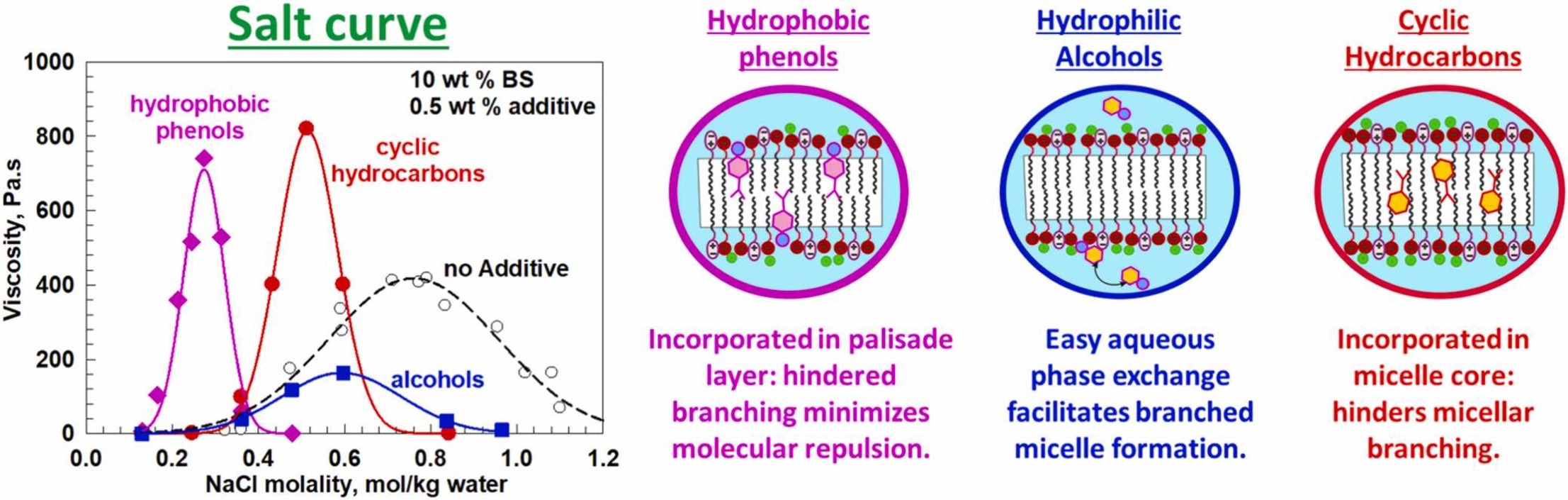
The effect of twelve cyclic molecules on the rheological response of a 10 wt% mixture of sodium lauryl ether sulfate and cocoamidopropyl betaine (BS) was evaluated. The results demonstrate that all studied additives effectively reduced the salt concentration required to reach peak viscosity and narrowed the width of the salt curve. The specific effect on the magnitude of the peak viscosity depends on the molecular structure of the additive. Hydrocarbons, along with hydrophobic phenols, increase the peak viscosity, while alcohols and simple phenol, decrease it. SAXS and NMR measurements revealed that hydrocarbons are primarily incorporated into the micellar core, and the observed viscosity enhancement is attributed to the suppression of micellar branching. In contrast, molecules possessing an OH-group intercalate between the surfactant headgroups or reside at the micellar surface. For hydrophobic phenols, the ability to form stable hydrogen bonds results in a significant increase in the maximum viscosity. This interaction substantially reduces the salt concentration required to reach peak viscosity; in this case, the micellar charge density remains relatively high, and electrostatic repulsion hinders micellar branching. On the other hand, simple phenols and alcohols decrease viscosity because their higher water solubility allows them to easily redistribute across different regions of the micelle surface, thereby facilitating micellar branching. The dimensionless parameters accounting for the effect of the studied additives on the salt curve characteristics were determined. These parameters were shown to depend on a composite molecular parameter, defined as the ratio of the surfactant volume to the additive volume multiplied by the octanol–water partition coefficient, vBS/vALogP.
Escin solutions: Effects of pH and electrolytes on their behavior
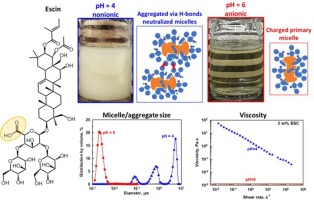
Escin is a triterpenoid saponin with one carboxyl group which is non-ionized at pH 4.7. The major aim of the current study is to determine how the electrolyte concentration affects the properties of concentrated escin solutions (5 wt% and 10 wt%) at pHs of 4, 6, and 8. Ionized escin molecules at pH >4.7 form charged micelles that repel one another when there is no added electrolyte and solutions remain clear and stable for more than a month. Lowering the pH to 4 leads to formation of uncharged micelles. These micelles attract each other and form inter-micellar hydrogen bonds, which enable formation of micrometer aggregates that cause turbidity and phase separation. The addition of background electrolytes to the solutions at pHs of 6 and 8 screens the electrostatic repulsion between micelles, causing partial aggregation of the micelles and gelation of solutions. As the salt concentration increases, the viscosity of the escin solution also increases, reaching a maximum—similar to the behavior observed with conventional surfactants. However, the mechanism behind this viscosity maximum is different. In solutions of conventional surfactants, the maximum is due to the formation of worm-like micelles, whereas the maximum for escin solutions is due to formation of a network of escin aggregates that imparts yield stress and elasticity to the solution. These dispersions remain stable for at least one month at room temperature and can be used as cosmetic and detergent formulations.
Role of food additives on properties of Polysorbate 60 solutions
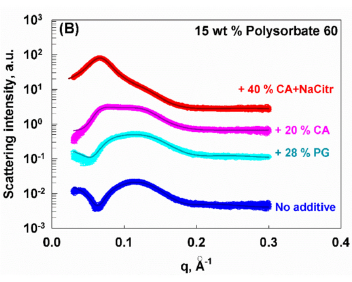
Polysorbates are hydrophilic, nonionic surfactants widely used in food, cosmetic, and pharmaceutical products. Often, these emulsifiers are used in combination with different preservatives, and it is essential to conduct an in-depth study of the influence of such additives on the properties of Polysorbate 60 solutions. In the current study, we investigated the effect of various food additives: citric acid, sodium benzoate, potassium sorbate, a mixture of citric acid and sodium citrate, and propylene glycol on the stability and micellar properties of Polysorbate 60 by using different experimental methods such as GC, DSC, SAXS, DLS, optical observations in polarised light, and NMR. When stored at room temperature without additives, solutions of Polysorbate 60 slowly undergo phase separation over time. Our results show that citric acid, a mixture of citric acid and sodium citrate, and propylene glycol increase the rate of this phase separation. In contrast, sodium benzoate and potassium sorbate are incorporated into the mixed micelles. They localize within the palisade layer, a region of the micelle where the surfactant tails begin, effectively preventing the phase separation. As a result, Polysorbate 60 solutions with these specific additives remain transparent and stable for over a year
Role of electrolytes and co-surfactants on the rheological properties of sodium N-acyl sarcosinate solutions
Alkyl sarcosinates are amino acid-based anionic surfactants commonly used as primary surfactants in sulfate-free personal care products. The major aim of this study is to identify the key factors influencing the rheological behaviour of sodium sarcosinate solutions and their mixtures with nonionic, zwitterionic, and cationic co-surfactants. To achieve this, we examined the effects of salt type and concentration for alkyl sarosinates with different chain lengths (dodecyl, tetradecyl, and cocoyl) across concentration range of 2–20 wt%. Experimental results reveal two distinct regions in the salt curve for the three studied sarcosinates. At low electrolyte concentrations, viscosity remains constant until reaching the critical electrolyte concentration, C1, beyond which viscosity increases logarithmically with salt concentration. Further electrolyte addition leads to phase separated solutions at the critical precipitation concentration, CTR. Both C1 and CTR decrease as the hydrocarbon chain length increases from dodecyl to tetradecyl. However, the presence of shorter chain molecules in cocoyl sarocisinate significantly increases both C1 and CTR due to the formation of spherical micelles. A theoretical expression for predicting viscosity dependence on salt concentration is derived and successfully applied to describe the experimental data. The adsorption energy of sodium and potassium to alkyl sacrosinate micelle surfaces is found to be much smaller than that to sodium lauroyl ether sulfate surfactants (1 vs. 3 kBT for Na+ and 0.8 vs. 3.8 kBT for K+). No significant effect of amphoteric co-surfactants, including cocoamidopropyl betaine, sulfobetaine, or decylamine oxide, is observed. NMR analysis confirms that cocoamidopropyl betaine and sodium dodecyl sarcosinate form mixed micelles that are structurally similar to sarcosinate micelles, as carboxyl groups remain exposed on the micelle surfaces in both cases. When using amine oxide and sulfobetaine, the increase in viscosity is attributed to the elongation of mixed micelles, though steric hindrance from side methyl groups limits their growth. The practical significance of this study lies in the finding that longer-chain alkyl sarcosinates (such as tetradecyl, as investigated here) can attain significantly higher viscosities at lower salt concentrations compared to shorter-chain analogs or surfactant mixtures. The scientific significance stems from the development of a theoretical model capable of predicting the viscosity of alkyl sarcosinate solutions across various surfactant and salt concentrations.
